

To help in an emergency, family and friends need to understand how a defibrillator works, what happens to the patient when fitted with one, and what to do when it operates. Make sure they have this basic knowledge:-
How does a defibrilator work?
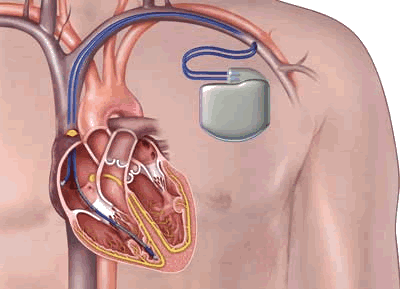
The implanted defibrillator [ICD] acts as a constant heart monitor through the leads that are attached to the patient’s heart & which feed signals back to the ‘box’ that sits under the skin. The ICD is set to detect heart rates that are higher than a pre-determined level that has been determined by your Cardiologist. The level will be different for each patient & will depend upon the patient’s underlying heart problem. The level may vary from 130 beats per minute [bpm] to 220 bpm.
If the monitored heart rhythm starts to go too fast, the ICD switches to full alert. If the rhythm remains above the set detection rate for a given period of time, the ICD begins a series of tests to determine whether the rhythm is normal or abnormal and, if abnormal, whether it needs to be treated. If so, it will start to deliver any therapy that has been programmed to attempt to return the rhythm to normal. If the patient’s rhythm then reverts back to normal on its own accord, the ICD will switch back to its normal monitoring setting. The treatment may be a delivery of fast pacing stimuli or a series of low/high level shocks. It will continue to treat the patient in this manner until either the heart rhythm returns to normal or until all of its treatments have been delivered. The number of treatments will depend upon the type of box that the patient has had implanted. This could be up to 7 shock therapies one after another – depending on whether the treatment from the device is successful at reverting the abnormal rhythm back to a normal one.
What happens to a patient during treatment?
A patient’s response will always vary depending on which type of therapy has been used. Many patients are unaware of pacing therapies that occur within their body, but most patients will be aware of a shock treatment if they were not unconscious at the time of the shock treatment. At the start of a fast heart rhythm, the patient may feel palpitations & begin to feel dizzy if their blood pressure drops with the increased heart rate. Some patients are not aware of their rhythm changing or any symptoms at all. However, in other cases, some patients may even lose consciousness. If you have time, the patient should always endeavour to sit down wherever they are. You must then wait for either the rhythm or palpitations to stop whilst your treatment from your ICD is being delivered. The effect of shock treatment can cause a violent twitching or jumping of the body. This can be unpleasant & the shock is felt in different ways by different patients. If you have had any symptoms or worry that you may have/be in a dangerous rhythm you should not attempt to drive.
What happens if the ICD fails to work?.
If the ICD delivers shocks & the patient has fainted or is unconscious, take their pulse immediately. If there is no pulse, then CPR [emergency heart massage & mouth – to – mouth breathing] should be immediately started & an emergency ambulance called. If the patient has a pulse & is breathing, help them into the most comfortable recovery position & summon help. If the ICD has delivered a shock & the pulse is still rapid, help should be called.
Many patients will not lose consciousness, even if they maintain a rapid pulse. This will give you adequate time to get them to the local hospital’s A&E department. Remember that you should not drive. Make certain that the paramedics are given all the relevant information that the patient has told you concerning their medical condition & ICD.
TRY NOT TO PANIC!! STAY CALM FOR THE SAKE OF THE PATIENT.
What does a patient do after they have receieved a shock?
If you think that you have had a shock from your ICD, you should immediately contact the ICD Clinic at your local hospital. If the shock occurs “out of hours” or you cannot get an answer from the local ICD Clinic; you must go to the A&E department at your local hospital. If you have more than one shock, you must attend the A&E department as soon as possible.
If a patient is experiencing a shock, would it affect anyone touching the patient?
Anyone touching a patient whose ICD is delivering shocks will experience no more than the patient’s minor physical jumping movement. The amount of electrical energy that is transmitted to the patient’s body surface is so little that it will not harm anyone else. Very occasionally, partners or people touching a patient’s body when the patient is receiving shocks have felt a slight tingle, but this is not harmful.
Know Your CPR
Watch the British Heart Foundation(BHF) video to understand when and how to apply CPR ( CardioPulmonary Resuscitation. )